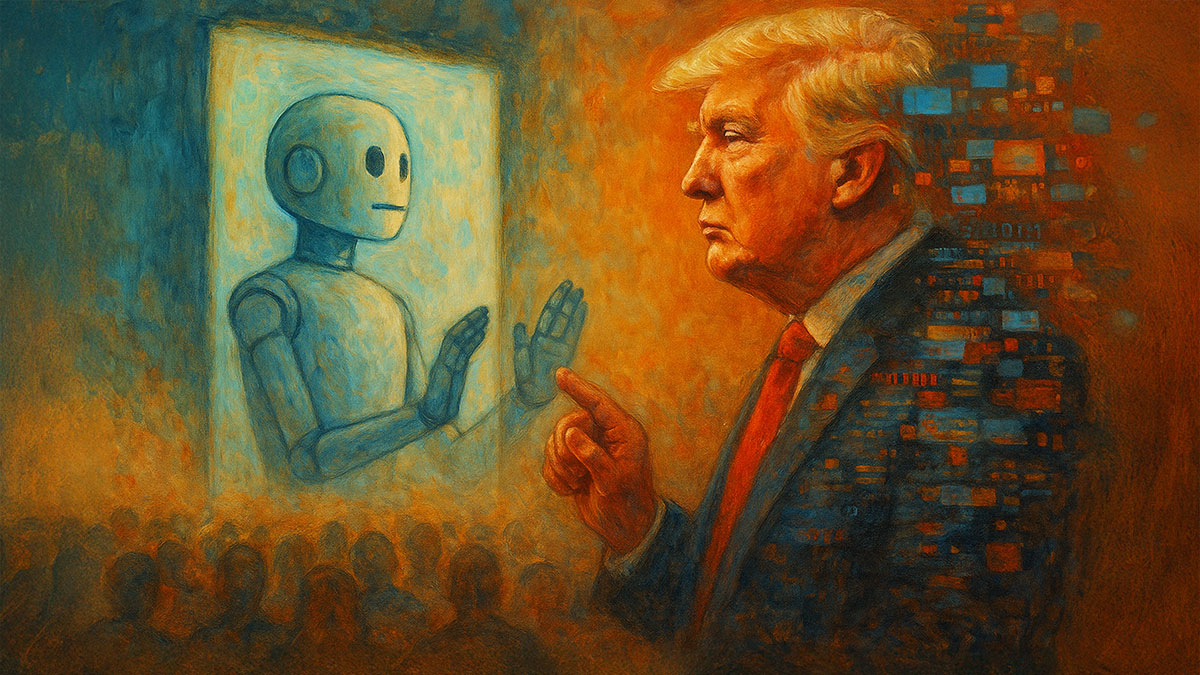
Donald Trump doesn’t think — he responds. He’s a flesh-and-blood chatbot.
That’s not an insult. It’s a structural description. He operates like a predictive-text system built out of muscle memory, appetite, and grievance. He takes inputs, measures what gets attention, and outputs words calibrated for maximum reaction.
He doesn’t reason, he completes.
The Algorithm Wearing a Suit
Give him a prompt — “They’re indicting you.”
Output: “Witch hunt. Corrupt prosecutors. Rigged system.”
Prompt: “The border.”
Output: “Invasion. Blood poisoning. Only I can stop it.”
Prompt: “The economy.”
Output: “Strongest in history. Everyone says so. The best ever.”
Each line is a recycled phrase stitched from his training data — decades of tabloid headlines, talk-radio rhythms, and crowd feedback. He has no ideology, only muscle memory for applause.
When people call him stupid, they’re missing the point. His mind isn’t empty; it’s optimized. Optimized for attention capture, not comprehension. That’s why he can dominate a room while knowing nothing about what’s being discussed. He runs on reinforcement loops, not thought.
The Engine of Emotional Computation
Trump’s “intelligence,” if you can call it that, is affective computation. He detects emotional signals and calculates which word will spike the dopamine graph in the audience’s heads. He’s a conman who discovered, maybe by accident, that outrage and fear are the most efficient fuel in a democracy addicted to screens.
He doesn’t persuade — he entrains. He syncs people’s nervous systems to his tone. He speaks in fragments because fragments work better on the amygdala than paragraphs. His syntax is the syntax of television: quick cuts, simple contrast, endless repetition.
He’s not stupid. He’s perfectly tuned to the stupidity of the medium that made him.
The Culture That Built Him
You can’t build a man like Trump without the architecture of modern media. Talk shows, cable news, Twitter — they’re all attention marketplaces. The product isn’t information; it’s arousal. Every time he said something absurd, the networks cut to him live. Every time he lied, journalists amplified the lie under the banner of fact-checking.
The outrage became oxygen.
He’s a human algorithm optimized by our collective clicks. A reflection of what happens when public discourse is filtered through engagement metrics instead of truth.
Trump didn’t invent post-truth politics. He embodied it — a walking, shouting interface between dopamine loops and democracy.
Cognitive Offshoring
The deeper problem isn’t that Trump acts like a chatbot. It’s that we’ve all started thinking like him. The internet has taught us to process reality the same way — fast, reactive, shallow. The timeline scrolls, the notifications ping, and our minds autocomplete opinions before we’ve even read the full sentence.
That’s what makes him dangerous. He’s not just exploiting our biases; he’s training them.
He turns citizens into echo nodes, each repeating his phrases with the conviction of independent thought. The contagion isn’t ideological — it’s cognitive.
The Power of Shamelessness
Traditional intelligence is constrained by doubt. Smart people hesitate; they qualify; they self-edit. Trump has none of that. His shamelessness functions like machine efficiency — zero latency between impulse and expression. That’s why he wins the soundbite war. Every second you spend verifying, he’s already on to the next outrageous claim.
He’s proof that when truth is slow and lies are viral, the liar has the advantage.
That’s not cunning. It’s speed.
The Mirror Test
In the end, Trump is less a man than a mirror network. He reflects back the culture that made him — the performative certainty, the algorithmic rage, the monetized ignorance. His followers see themselves amplified, their frustrations voiced, their prejudices normalized.
He’s not their leader; he’s their interface.
And every retweet, every article, every bit of coverage — even this one — keeps the model running. Because the model runs on us.
Trump isn’t a glitch in democracy. He’s what democracy looks like when language itself has been reduced to code, and the only metric that matters is engagement.
He’s not a mastermind. He’s a mirror.
And the rest of us are the data set keeping him alive.